
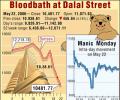
It was a manic Monday for the Indian markets with the benchmark Bombay Stock Exchange Sensex slipping to its second biggest points' fall and the lowest since August in line with an Asia-wide slide after the Federal Reserve cut its discount interest rate at an emergency meeting and JPMorgan Chase agreed to buy sub-prime hit Bear Stearns for less than a tenth of its value last week.
I think the Indian economy is poised to grow at over 8.5% and looks to continue for atleast another 4 to 5 years, says market expert Pranav Sanghavi.
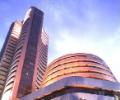
The BSE Sensex may surpass the much-awaited 21,000-mark before the festival of Diwali, driven by the strong FII interest, analysts said.
Capital goods, realty and power stocks led from the front while losses in oil & gas heavyweights offset the gains.
Switzerland-based bank Credit Suisse said on Tuesday it expects the Bombay Stock Exchange's 30-stock barometer Sensex to touch the 22,000 mark in 12 months.
Investors might soon get to bet on various versions of the Bombay Stock Exchange's (BSE) benchmark index, the Sensex, and its other key gauges soon.

A day after Standard & Poor's (S&P) came out with its report on how India could be the first among Brazil, Russia, India and China (BRIC nations) to lose its investment-grade rating, markets shrugged off the concern, ending in the green.

Markets have opened marginally higher ignoring subdued global cues. The Sensex has advanced 51 points to 17,443 and the 50-share Nifty has opened higher by 14 points at 5,289 levels.
The National Stock Exchange on Wednesday removed Satyam from its benchmark index Nifty and the IT firm will be replaced by Reliance Capital with effect from January 12.
Signaling a growing clout of Indian blue chip banking scrips among foreign investors, HDFC Bank has joined ICICI Bank in the top five Sensex scrips held by foreign institutional investors

According to a report 62 markets worldwide are now up.
It's been a tough three years for retail investors. With the Sensex giving barely 4 per cent annual returns, even lesser than the inflation rate, it is very difficult to keep waiting. Investors are, therefore, booking profit and exiting the markets. Should you?
Challenging the Bombay Stock Exchange, which has applied to register Sensex as its trademark, Deepak Mohoni, a stock market analyst in Pune, has filed his own plea with the Trademark registry claiming that the word had been coined by him to denote the BSE sensitive index in his newspaper columns before BSE started using it.
Sensex had opened on a shaky note at 15,838.63 but managed to recoup all the losses and rebound into the positive terrain for a short while to touch a high of 15,957.06. However, the weak opening of the European markets, coupled with subdued Asian markets, pushed the index into the red and slip to a low of 15,330.56. Intraday volatility on the bourses was high and the index moved in the range of 627 points in the day.
It is quite possible if India's growth story is intact.
The benchmark index closed at 13,315.60 on September 18, after touching 12,558.14, below its May 2006-level. Interestingly, small-cap and mid-cap indices fell by over 15 per cent each, despite the Sensex and Nifty gaining 6 per cent since then.
The Sensex plunged over 330 points in tandem with rupee breaching 64-mark but regained lost ground end only 61 points lower.
Private sector banks also plunged into the negative territory with country's largest private lender ICICI Bank registering a fall of nearly 10 per cent and HDFC Bank dipped 5.7 per cent.
60% stocks in BS 200 underperform the Sensex in 2011.

Equity benchmark Sensex ended marginally higher after a choppy session on Friday as concerns over the economic impact of the second wave of Covid-19 and pace of vaccination weighed on investor sentiment.

The Bombay Stock Exchange's benchmark Sensex is likely to hit the much awaited psychological level of 21,000 this week, driven by the smart Reliance numbers and expectations of robust listing of the Coal India IPO, say analysts.
Based on the current scenario, he classifies real estate as the highest in the risk grade, followed by infrastructure companies involved in construction, hotels, commodities and auto.
FIIs pour $2 bn in January; flows into India equity funds hit 54-week high; doubts on sustainability persist.
Since its low on July 26, the US dollar index has gained a little over eight per cent. In the same period, the Bombay Stock Exchange Sensitive Index, or Sensex, has lost 12.4 per cent, establishing a negative correlation of about 1.5 times.
Check out the historic rise of the BSE Sensex over the years.
The NSE Nifty ended at 4,399, down 70 points. Good first-quarter results by India's electric equipment maker BHEL and the third-largest software exporter Wipro did not impact the market.
